what we see in our night sky in 3d in reference to the milky way
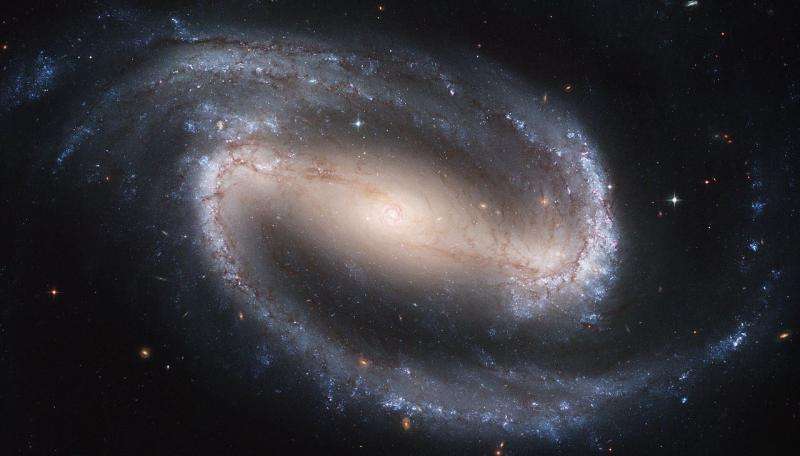
For millennia, homo beings take stared up at the night sky and stood in awe of the Galaxy. Today, stargazers and amateur astronomers go on in this tradition, knowing that what they are witnessing is in fact a collection of hundreds of millions of stars and grit clouds, not to mention billions of other worlds.
But 1 has to wonder, if we tin see the glowing band of the Milky Style, why can't nosotros see what lies towards the heart of our galaxy? Assuming we are looking in the right management, shouldn't we able to see that big, brilliant burl of stars with the naked center? You know the one I mean, it's in all the pictures!
Unfortunately, in answering this question, a number of reality checks have to exist made. When it is dark enough, and atmospheric condition are clear, the dusty ring of the Milky Fashion can certainly exist discerned in the night sky. Even so, we tin notwithstanding merely see about 6,000 light years into the disk with the naked eye, and relying on the visible spectrum. Here'south a rundown on why that is.
Size and Structure:
First of all, the sheer size of our galaxy is enough to boggle the mind. NASA estimates that the Milky Way is between 100,000 – 120,000 light-years in diameter – though some information suggests it may be as much as 150,000 – 180,000 light-years across. Since one calorie-free yr is nigh ix.5 10 1012km, this makes the diameter of the Milky way galaxy approximately 9.5 10 1017 – one.14 10 1018 km in bore.
To put that in layman's terms, that 950 quadrillion (590 quadrillion miles) to 1.14 quintillion km (7oo septendecillion miles). The Milky Fashion is likewise estimated to comprise 100–400 billion stars, (although that could be every bit high as one trillion), and may have as many equally 100 billion planets.
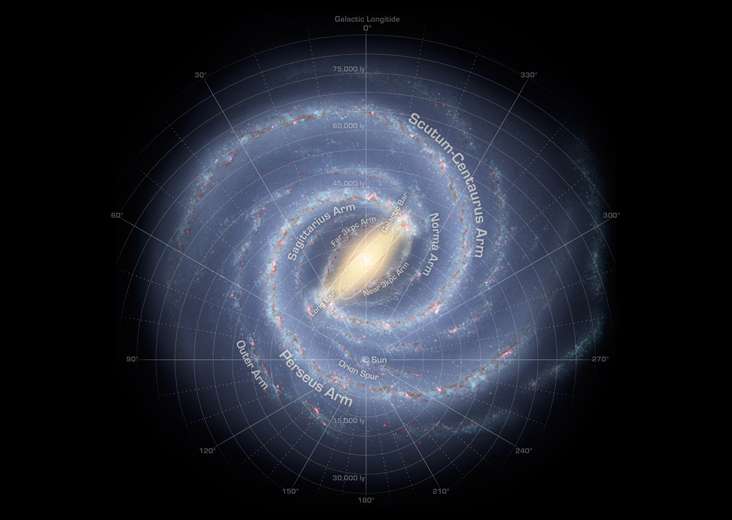
At the center, measuring approx. 10,000 light-years in diameter, is the tightly-packed group of stars known as the "bulge". At the very center of this bulge is an intense radio source, named Sagittarius A*, which is likely to be a supermassive black hole that contains 4.1 million times the mass of our Sun.
We, in our humble Solar System, are roughly 28,000 light years away from it. In short, this region is just too far for the states to see with the naked eye. However, there is more than to it than just that…
Low Surface Brightness:
In improver to being a spiral barred galaxy, the Milky Way is what is known as a Low Surface Brightness (LSB) galaxy – a classification that refers to galaxies where their surface brightness is, when viewed from World, at least i magnitude lower than the ambient night sky. Essentially, this ways that the sky needs to be darker than about 20.2 magnitude per foursquare arcsecond in order for the Milky way to exist seen.
This makes the Galaxy difficult to see from any location on Earth where light pollution is common – such as urban or suburban locations – or when stray light from the Moon is a gene. Only even when conditions are optimal, at that place still but so much we can see with the naked heart, for reasons that accept much to practise with everything that lies between us and the galactic cadre.
Dust and Gas:
Though it may non wait similar information technology to the casual observer, the Milky way is full of dust and gas. This matter is known as as the interstellar medium, a disc that makes up a whopping ten-15% of the luminous/visible matter in our milky way and fills the long spaces in between the stars. The thickness of the grit deflects visible light (every bit is explained hither), leaving simply infrared light to pass through the dust.
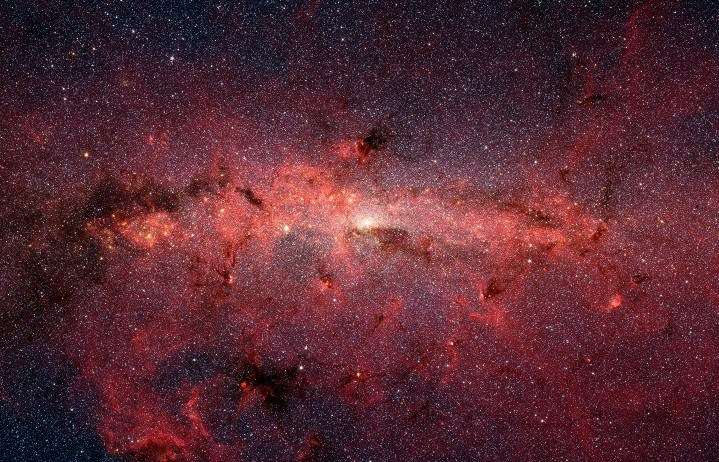
This makes infrared telescopes like the Spitzer Space Telescope extremely valuable tools in mapping and studying the galaxy, since it can peer through the dust and brume to give us extraordinarily clear views of what is going on at the heart of the galaxy and in star-forming regions. However, when looking in the visual spectrum, light from Earth, and the interference effect of dust and gas limit how far we can meet.
Limited Instrumentation:
Astronomers have been staring up at the stars for thousands of years. Notwithstanding, information technology was just in insufficiently recent times that they even knew what they were looking at. For instance, in his volume Meteorologica, Aristotle (384–322 BC) wrote that the Greek philosophers Anaxagoras (ca. 500–428 BCE) and Democritus (460–370 BCE) had proposed that the Galaxy might consist of afar stars.
Nevertheless, Aristotle himself believed the Milky Way was be acquired past "the ignition of the peppery exhalation of some stars which were big, numerous and close together" and that these ignitions takes place in the upper part of the temper. Like many of Aristotle's theories, this would remain catechism for western scholars until the 16th and 17th centuries, at which time, modernistic astronomy would begin to have root.
Meanwhile, in the Islamic world, many medieval scholars took a different view. For example, Persian astronomer Abu Rayhan al-Biruni (973–1048) proposed that the Milky Fashion is "a drove of countless fragments of the nature of nebulous stars". Ibn Qayyim Al-Jawziyya (1292–1350) of Damascus similarly proposed that the Milky Way is "a myriad of tiny stars packed together in the sphere of the stock-still stars" and that these stars are larger than planets.
Persian astronomer Nasir al-Din al-Tusi (1201–1274) likewise claimed in his book Tadhkira that: "The Milky Mode, i.e. the Galaxy, is made upwardly of a very large number of pocket-sized, tightly clustered stars, which, on business relationship of their concentration and smallness, seem to be cloudy patches. Because of this, information technology was likened to milk in colour."
Despite these theoretical breakthroughs, it was non until 1610, when Galileo Galilei turned his telescope towards the heavens, that proof existed to back up these claims. With the help of telescopes, astronomers realized for the starting time time that there were many, many more stars in the heaven than the ones we tin can see, and that all of the ones that nosotros can see are a part of the Milky Manner.
Over a century later on, William Herschel created the first theoretical diagram of what the Milky Fashion (1785) looked like. In information technology, he described the shape of the Galaxy as a big, deject-similar collection of stars, and claimed the Solar System was close to the middle. Though erroneous, this was the first attempt at hypothesizing what our catholic backyard looked like.
Information technology was non until the 20th century that astronomers were able to become an accurate picture show of what our Milky way actually looks like. This began with astronomer Harlow Shapely measuring the distributions and locations of globular star clusters. From this, he determined that the middle of the Galaxy was 28,000 lite years from Globe, and that the center was a burl, rather than a flat expanse.
In 1923, astronomer Edwin Hubble used the largest telescope of his day at the Mt. Wilson Observatory near Pasadena, Calif., to notice galaxies beyond our own. Past observing what spiral galaxies look similar throughout the universe, astronomers and scientists were able to get an idea of what our own looks similar.
Since that time, the ability to notice our galaxy through multiple wavelengths (i.e. radio waves, infrared, 10-rays, gamma-rays) and not but the visible spectrum has helped united states to become an even ameliorate movie. In add-on, the development of space telescopes – such equally Hubble, Spitzer, WISE, and Kepler – accept been instrumental in allowing united states to make observations that are not subject to interference from our temper or meteorological weather condition.
But despite our best efforts, nosotros are still limited by a combination of perspective, size, and visibility barriers. So far, all pictures that depict our galaxy are either artist'southward renditions or pictures of other screw galaxies. Until quite recently in our history, it was very difficult for scientists to estimate what the Milky way looks like, mainly considering we're embedded inside it.
To get an actual view of the Milky Fashion Galaxy, several things would need to happen. Outset, we would need a photographic camera that worked in space that had a wide field of view (aka. Hubble, Spitzer, etc). Then we'd need to wing that camera to a spot that's roughly 100,000 light years above the Milky way and point information technology back at Earth. With our electric current propulsion technology, that would take 2.ii billion years to attain.
Fortunately, as noted already, astronomers have a few boosted wavelengths they can employ to encounter into the milky way, and these are making much more of the galaxy visible. In addition to seeing more stars and more star clusters, we're able to run into more than of the center of our Galaxy as well, which includes the supermassive black pigsty that has been theorized every bit existing there.
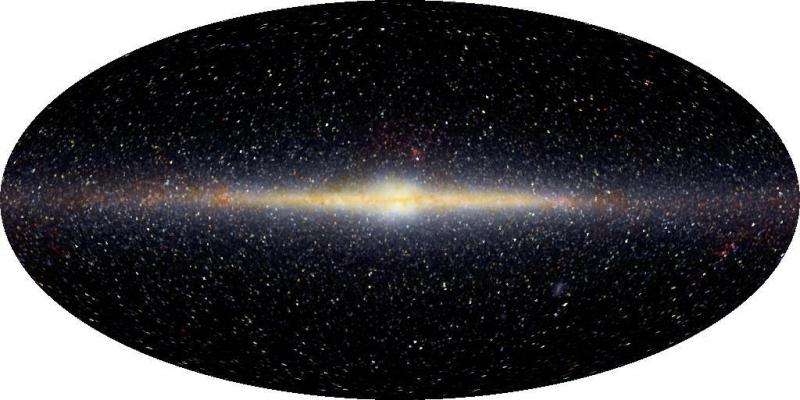
For some time, astronomers have had name for the region of sky that is obscured by the Galaxy – the "Zone of Abstention". Back in the days when astronomers could only make visual observations, the Zone of Abstention took upwards about twenty% of the night sky. But by observing in other wavelengths, like infrared, ten-ray, gamma rays, and especially radio waves, astronomers tin come across all but about x% of the sky. What's on the other side of that 10% is mostly a mystery.
In short, progress is being made. Just until such time that we tin send a transport beyond our Milky way that can take snapshots and beam them back to united states, all within the space of our own lifetimes, nosotros'll exist dependent on what we can notice from the inside.
Citation: Why tin can't nosotros run across the middle of the Milky Mode? (2015, July 10) retrieved 9 Apr 2022 from https://phys.org/news/2015-07-center-milky.html
This document is field of study to copyright. Apart from any fair dealing for the purpose of private study or inquiry, no function may be reproduced without the written permission. The content is provided for information purposes but.
martinezpatml1982.blogspot.com
Source: https://phys.org/news/2015-07-center-milky.html

Post a Comment for "what we see in our night sky in 3d in reference to the milky way"